Topics Discussed
- Introduction - The Screenless Trend
- Side-by-Side Comparison Table
- The Philosophy of Screenless Design
- Battery Life & Charging Speeds
- Ecosystems, Apps & Sensor Precision
- Water Resistance, Troubleshooting & Sustainability
- Pricing, Materials & Comfort
- Final Verdict - Which Wearable Wins?
- Frequently Asked Questions
Introduction - The Screenless Trend
Smartwatches have dominated our wrists for a decade, but a new trend is emerging: distraction-free wellness tracking. The Amazfit Helio Strap and the Google Fitbit Air are minimalist, screen-free fitness trackers. They skip display panels entirely, prioritizing ultra-light comfort, long battery life, and discrete, continuous data monitoring.
But while they share a screenless philosophy, they differ in sensor configurations, companion app models, charging speeds, and overall pricing structures. Let's look at how the Helio Strap and Google's Fitbit Air compare side-by-side.
Side-by-Side Comparison Table
Below is a direct comparison of their technical specifications:
| Specification | Amazfit Helio Strap | Google Fitbit Air |
|---|---|---|
| Display | None (Screen-free) | None (Screen-free) |
| Battery Life | Up to 10 days (typical) | Up to 7 days |
| Charging Time | Under 2 hours (0 to 100%) | 90 min (Quick charge: 5 min for 1 day) |
| Weight (Without Band) | Ultra-light (Fabric strap integration) | 5.2 g (12 g with standard band) |
| Sensors Included | BioCharge optical heart rate monitor | Optical HR, 3-axis accelerometer + gyro, SpO2, skin temp |
| Water Resistance | 5 ATM (50 meters / 164 feet for 10 min) | 5 ATM (50 meters) with dry coating |
| Companion App & Sync | Zepp App (Strava, adidas Running, TrainingPeaks, Komoot, Apple Health, Google Fit) | Google Health App (Fitbit Premium option) |
| Device Compatibility | Apple iOS & Android (Samsung, Google, etc.) | Apple iOS & Android |
| Price | ₹8,999 | $99.99 (approx. ₹8,499) |
The Philosophy of Screenless Design
Both wearables remove the constant notifications and screen-glance loops. They are built to collect metrics passively, sending data to your phone via Bluetooth. They lack watch faces, touch areas, and buttons.
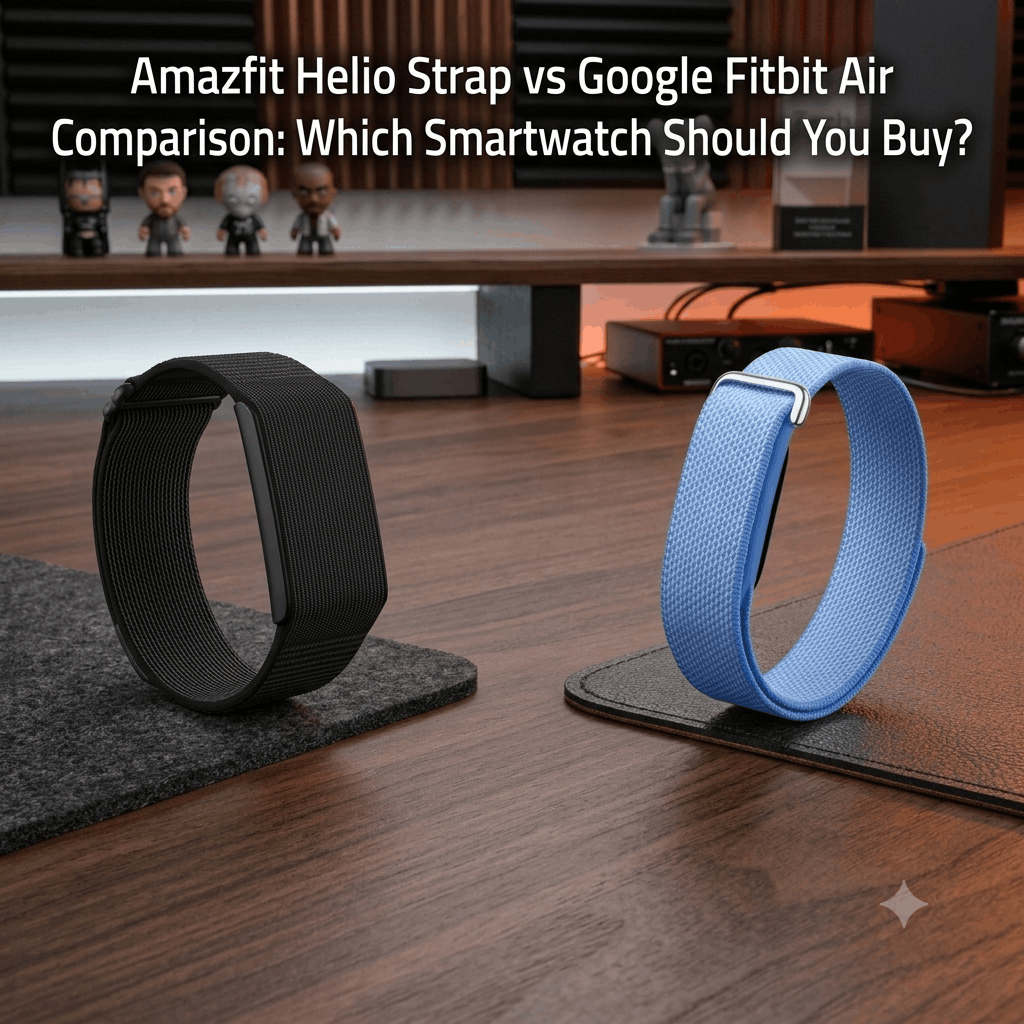
The Amazfit Helio Strap is designed as a comfortable fabric band. It integrates with other Amazfit devices (like the Helio Ring) to build a unified recovery and sleep score in the Zepp ecosystem. The Google Fitbit Air is a tiny tracking capsule (weighing just 5.2 grams) that clips into silicone or textile bands. It is exceptionally small and vanishes on your wrist.
Battery Life & Charging Speeds
Without displays, both wearables outpace traditional smartwatches in battery life:
- Amazfit Helio Strap: Offers up to 10 days of battery life under typical usage, capturing continuous heart rate metrics every single second. From empty, it takes less than 2 hours to reach a full 100% charge.
- Google Fitbit Air: Delivers up to 7 days of tracking. It compensates with Quick Charging, providing 1 full day of battery life in only 5 minutes of charging, and goes from 0 to 100% in 90 minutes.
Ecosystems, Apps & Sensor Precision
Your choice depends on the companion app and subscription model:
- Amazfit Ecosystem & Sync: The Helio Strap uses the Zepp App, providing BioCharge™ recovery analysis, sleep metrics, and stress graphs with no monthly subscription fees. The Zepp app syncs your fitness data directly with popular platforms including Strava, adidas Running, TrainingPeaks (via Terra), komoot, Relive, Google Fit, and Apple Health (Samsung Health and MyFitnessPal are not supported).
- Google Fitbit Ecosystem: The Fitbit Air integrates with the Google Health App (requiring a Google Account). It is packed with hardware, including a skin temperature sensor and a red/infrared SpO2 sensor for blood oxygen tracking. However, unlocking advanced metrics (like readiness scores and personalized sleep profiles) requires a Fitbit Premium subscription.
Water Resistance, Troubleshooting & Sustainability
Both devices are built for active, rugged environments:
- 5 ATM Water Resistance: The Amazfit Helio Strap features a 5 ATM water-resistance grade, enabling it to withstand static water pressure up to 50 meters (164 feet) for up to 10 minutes.
- Eco-Friendly Packaging (No USB-C Cable): Amazfit is committed to sustainability and waste reduction, omitting USB-C cables from the package as most users own spares. Support is reachable via support.na@amazfit.com.
- Cross-Platform Compatibility: Amazfit Helio Strap works seamlessly with both Apple iOS and Android OS devices (Samsung, Google, etc.).
- Bluetooth Troubleshooting: If your Amazfit device Bluetooth keeps disconnecting, ensure both the Zepp app and phone OS are updated, restart your device, reconnect via Bluetooth, or perform a factory reset if issues persist.
Pricing, Materials & Comfort
Comfort levels differ based on the band structures:
- The Helio Strap uses a breathable, flexible fabric band designed for gym use. Worn day or night, it adjusts smoothly and retails at ₹8,999 in India.
- The Fitbit Air features a recycled polycarbonate housing with multiple band styles (Silicone and Textile). Google even offers a Special Edition Stephen Curry Band. It is priced starting at $99.99 (approx. ₹8,499).
Final Verdict - Which Wearable Wins?
Buy the Amazfit Helio Strap if:
- You want the longest battery life (up to 10 days, fully charged in under 2 hours).
- You want 5 ATM water resistance (50m depth) for swim tracking.
- You want seamless data syncing with Strava, adidas Running, TrainingPeaks, Komoot, Apple Health, and Google Fit.
- You refuse to pay monthly subscriptions to view your recovery data.
- You already own or plan to buy other Amazfit devices (smartwatch or Helio Ring) to use the Zepp ecosystem.
- You prefer soft, breathable fabric straps right out of the box.
Buy the Google Fitbit Air if:
- You want an extremely tiny, modular tracker (only 5.2g) that fits various band styles.
- You require advanced hardware features like skin temperature variation and blood oxygen (SpO2) sensors.
- You already use Google Health and prefer Google's analytics.
- You want quick charging to top up 1 day of battery in 5 minutes.
Frequently Asked Questions
Yes, Amazfit Helio Strap is compatible with both Apple iOS and Samsung, Google or other Android OS based mobile phones.
The Amazfit Helio Strap provides up to 10 days of battery life under typical use and takes less than 2 hours to fully charge from empty.
Yes, the Zepp app syncs with Strava, adidas Running, TrainingPeaks (via Terra), komoot, Relive, Google Fit, and Apple Health. Other apps such as Samsung Health or MyFitnessPal do not sync.
The Helio Strap features a water-resistance grade of 5 ATM, meaning it can withstand pressure equivalent to 50 meters (164 feet) of static water depth for up to 10 minutes.
Amazfit is committed to sustainability, striving to minimize environmental impact and promote waste reduction across its products and operations. Many users already have an extra unused USB-C cable. If you do not have one, reach out to Customer Support at support.na@amazfit.com.
Ensure both the Zepp app and your device's operating system are up to date. Restart your device, then try reconnecting via Bluetooth. If the problem persists, perform a factory reset or contact support at support.na@amazfit.com.
A screenless fitness tracker has no display panel, buttons, or watch face, using your phone's companion app instead. It is chosen to eliminate screen distractions, improve battery life, and maintain a lightweight form factor.
The Amazfit Helio Strap does not require any paid subscription for its core data. The Google Fitbit Air utilizes the Google Health app, which provides standard tracking for free, but requires a Fitbit Premium subscription to unlock advanced wellness scores and coaching.
The Amazfit Helio Strap is priced at ₹8,999 in India, whereas the Google Fitbit Air is priced starting at $99.99 (approximately ₹8,499) in the US store.